FiberBrowser
FiberBrowser is an interactive, single-molecule-genomics-focused genome browser for DAF-seq, Fiber-seq, and a variety of other genomic datatypes. It is the visualization component of the FiberHMM pipeline, but does not require footprints to be useful. It allows fast and convenient exploration and quantitative analysis of per-read footprinting and methylation/deamination patterns across 1000s of reads, providing extensive functionality missing from modern browsers which focus on aggregate short-read tracks.
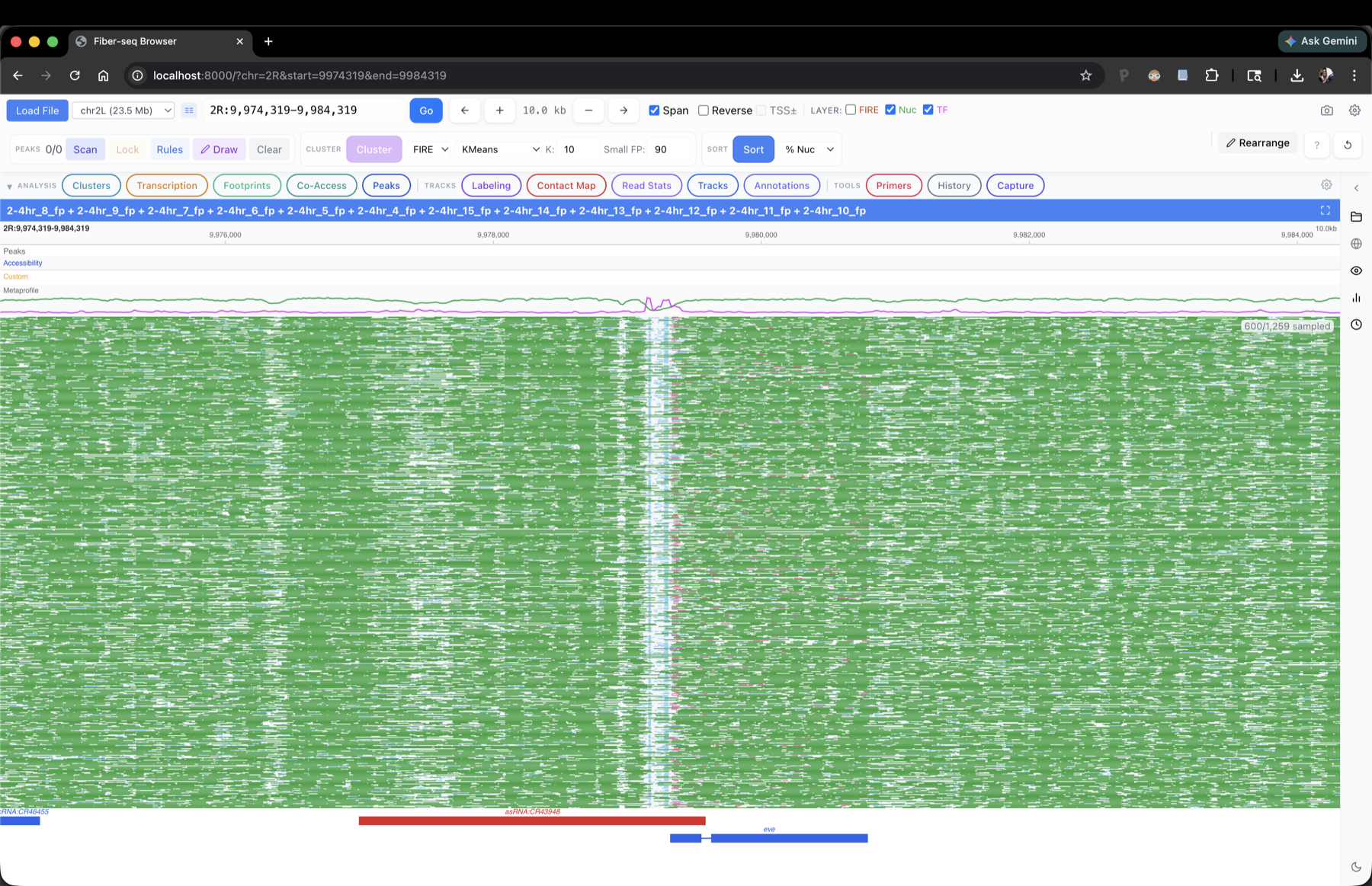
2-4 hr Fiber-seq at the eve locus in Drosophila embryos. 1,259 reads span the region; the browser draws every footprint on every read, and every downstream analysis is computed on the full read set.
Features
- Per-read heatmaps of m6A / DAF accessibility, drawn as a single canvas layer so loci with thousands of reads stay responsive.
- Single-molecule clustering on CRE accessibility patterns, with per-cluster metaprofiles, merge / reorder / hide controls, and a sortable read table.
- Direct comparison across perturbations or timepoints -- load multiple datasets at once and joint-cluster them so the same single-molecule state definitions apply across conditions, making perturbation effects readable at single-read resolution.
- Customizable footprint labeling -- recolor footprints by user-defined rules (Pol II, NFR, TF, nucleosome) using size and overlap criteria.
- Transcription-state quantification -- filter and count reads matching paused, PIC, elongating, or hyperbound Pol II configurations at a selected gene.
- Footprint inspection and motif enrichment -- pull motif hits and FASTA for any single footprint and compare to references (ChIP-nexus, motif databases).
- DAF-seq primer design -- design and BLAST-check primers for targeted DAF-seq amplicons directly from the browser, with IDT / Twist CSV export. See also the Primer Design guidelines.
- Headless / API mode and Jupyter control -- drive the browser programmatically via its FastAPI endpoints or a Python client; load regions, pull cluster assignments, fetch co-accessibility matrices, and render figures directly from a notebook.
- Local LLM copilot (optional) -- natural-language commands that drive the browser via a model running on your machine (MLX on Mac, Ollama elsewhere); doubles as an interactive tutorial for discovering features.
- ...and more.
FiberBrowser sits downstream of the DAF-QC Pipeline: once you have QC'd reads and called footprints, FiberBrowser is where you explore them.
Early access
FiberBrowser is in pre-release while we finalize the public repository. If you'd like to try it on your data, reach out at tommywtullius [at] gmail.com.