FiberBrowser: a genome browser for single molecules


FiberBrowser is an interactive genome browser for single-molecule chromatin data: Fiber-seq (m6A, PacBio or Oxford Nanopore) and DAF-seq (deamination, DddB or SsDddA). Most browsers summarise reads into coverage tracks. FiberBrowser draws every molecule as its own row, with its nucleosomes, transcription-factor and other small footprints, accessible DNA and base modifications, and lets you analyse those molecules as a population: cluster them, compare datasets, split them by haplotype or allele, and export figures and the numbers behind them.
It does not need footprint calls. Open any Fiber-seq or DAF-seq BAM and FiberBrowser draws each molecule's raw modification pattern, its m6A, 5mC or deamination marks, so you can explore data before calling footprints or without calling them at all. When footprints have been called, by FiberHMM, which FiberBrowser installs and runs, the nucleosome and footprint layers appear on top. FiberHMM writes its calls into the BAM as Molecular-annotation tags, so the same calls feed FiberBrowser, FIRE and your own scripts.
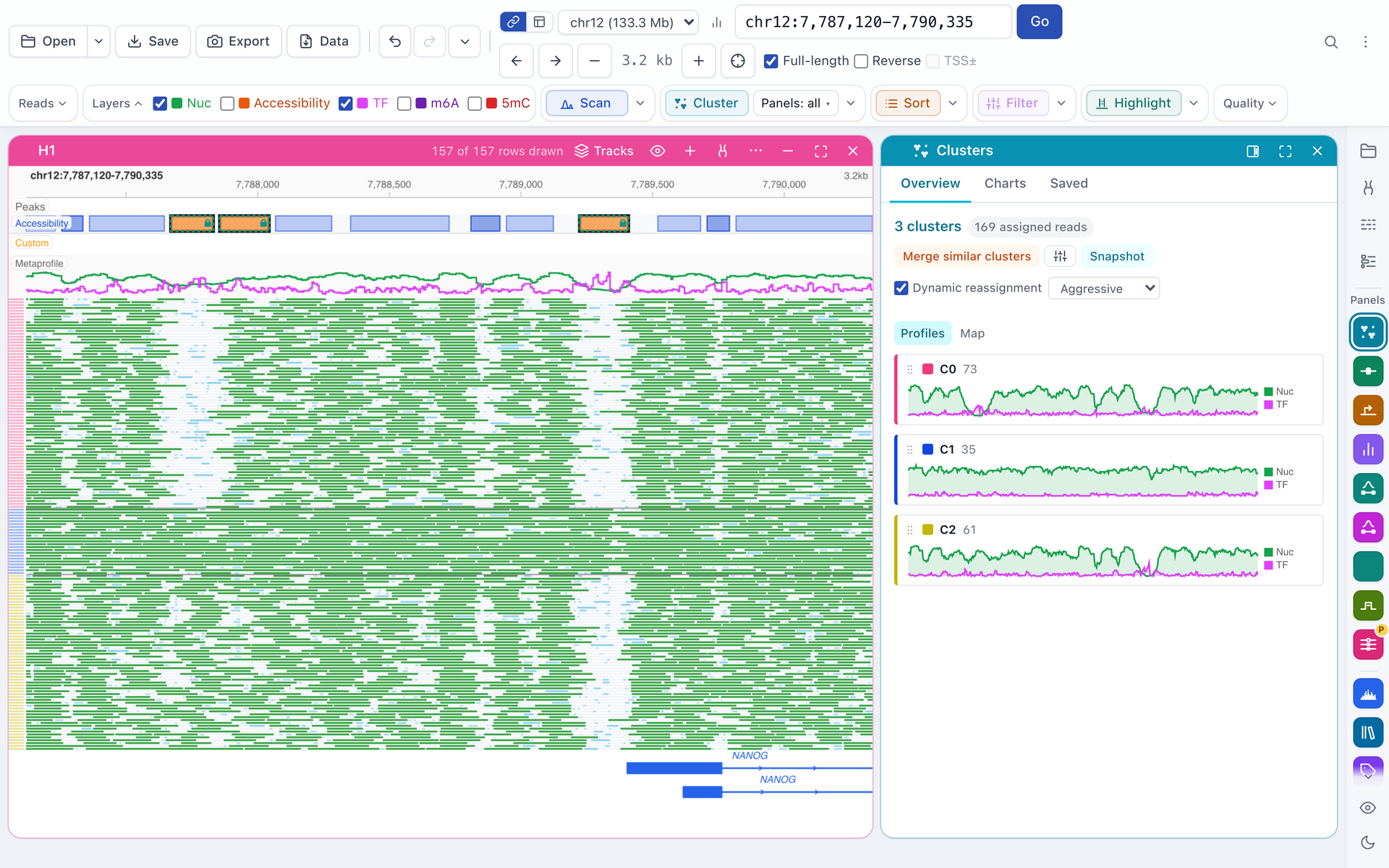
H1 Fiber-seq at NANOG. Each row is one molecule, grouped into three clusters by its footprints at the selected peaks; the Clusters panel on the right shows their sizes and average profiles. From the preprint.
What you can do with it
- See every molecule. Each read is drawn with its calls, at thousands of reads per locus.
- Work from raw marks. Without footprint calls, explore the raw deamination or methylation patterns of each molecule directly.
- Turn a locus into a population analysis. Cluster molecules by their footprints at chosen peaks, compare cluster proportions across datasets with confidence intervals, and sort or filter by any footprint.
- Find recurrent footprints. Footprint classes groups footprints that recur at the same place across molecules and measures how often each molecule carries them; co-occupancy tests which footprints occur together on the same molecules.
- Compare alleles on single fibers. Split molecules by haplotype, by a variant's base, or by carriage of a structural variant, and expand an insertion to see the chromatin inside it.
- Export. Figures as PNG, SVG or PDF, and the per-read data behind every panel.
- Script it. A Python API and Jupyter integration drive the same engine.
In this chapter
- Getting started: install, open your data, and read the view.
- A tour of the features: clustering, footprint classes, haplotypes and variants, export.
The source code and full documentation are on GitHub; the user guide covers every feature.
Cite
FiberBrowser and FiberHMM are described in:
Tullius, T. W., Catalano, C., Ranchalis, J., Hu, J., Vollger, M. R., Stergachis, A. B., & Levine, M. S. (2026). FiberBrowser: a unified framework for single-molecule genomics. bioRxiv. https://doi.org/10.64898/2026.10.29.762797